
People & Blogs
What Happens When Your Dog Uses the Internet | Ilyena Hirskyj-Douglas | TED
Imagine this: you walk into a room, and your dog is on a video call with their fellow canine friends. Computer scientist Ilyena Hirskyj-Douglas thinks the notion of a social internet for animals is not far off. She explores what happens when animals control their own technology — from parrots making friends online to monkeys…













People & Blogs
How to Confront Your Inner Critic (W/ Anu Gupta) | How to Be a Better Human | TED
How do you quieten the judgmental voice in your head? Educator and entrepreneur Anu Gupta suggests you actually listen to it.Anu joins Chris to discuss the effects of human biases on our psyche and how to combat self-destructive habits by swapping out harmful emotions with constructive thoughts. They also talk about how individuals, when they…

People & Blogs
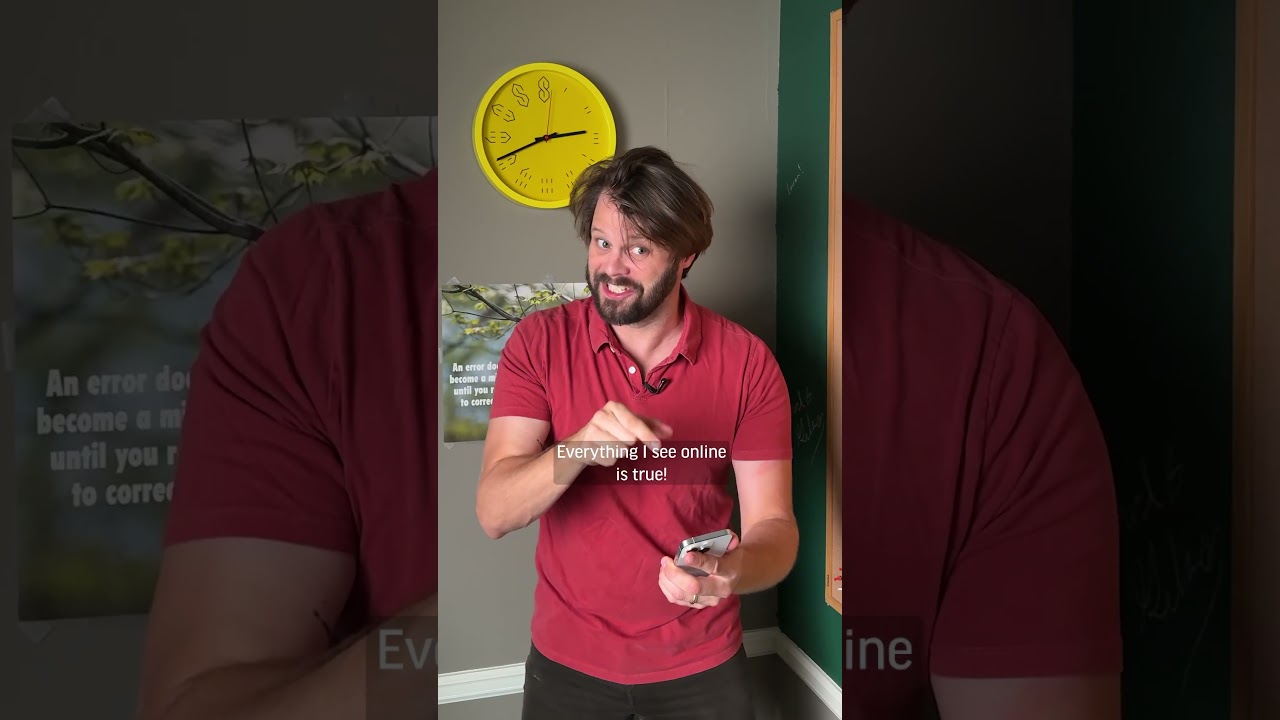
Fake news is everywhere — @DaveJorgenson says respond with a punchline #TEDTalks
What if the best defense against misinformation isn’t panic, but a punchline? Journalist and comedian Dave Jorgenson explores how misinformation has proliferated throughout history — from the age of Plato to the era of viral TikToks. With his own short, absurdist sketches that explain the news, he shows how humor can cut through fear, spark…
People & Blogs
Is Luck Random — or Can You Cultivate It? | Christian Busch | TED
When the 2025 Los Angeles wildfires destroyed his home and neighborhood, scientist Christian Busch encountered the opposite of serendipity: “zemblanity,” or bad luck by design. Drawing on more than a decade of scientific research, he explores how people can navigate unpredictability by adopting a serendipity mindset that transforms setbacks into unexpected new beginnings. He asks:…



Tech Stocks Rally on the Back of US-Iran Ceasefire Deal | Bloomberg Tech 4/8/2026

Snowflake Seeing Strong Return on AI Investment: CEO

Apple’s Foldable Phone On Track for September Launch
-

 Science & Technology6 years ago
Nitya Subramanian: Products and Protocol
-

 People & Blogs4 years ago
Sleep Expert Answers Questions From Twitter ???? | Tech Support | WIRED
-

 CNET6 years ago
Ways you can help Black Lives Matter movement (links, orgs, and more) ????????
-

 Wired7 years ago
How This Guy Became a World Champion Boomerang Thrower | WIRED
-

 Wired7 years ago
Neuroscientist Explains ASMR’s Effects on the Brain & The Body | WIRED
-

 Wired7 years ago
Why It’s Almost Impossible to Solve a Rubik’s Cube in Under 3 Seconds | WIRED
-

 Wired7 years ago
Former FBI Agent Explains How to Read Body Language | Tradecraft | WIRED
-

 CNET6 years ago
Surface Pro 7 review: Hello, old friend ????
@sibaprasadswain8520
October 22, 2025 at 11:33 am
From india🇮🇳🇮🇳🇮🇳🇮🇳🇮🇳🇮🇳🇮🇳🇮🇳🇮🇳🇮🇳🇮🇳🇮🇳
@Harshiiitt
October 22, 2025 at 11:33 am
You people out of topics lol 😂😂😂😂😂😂
@makaan1932
October 22, 2025 at 11:37 am
“journey” is a word used so wrong so often, it has lost any and all meaning
@RajibRana-m4m
October 22, 2025 at 11:45 am
from Bangladesh
@hmjahid424
October 22, 2025 at 11:47 am
🇧🇩🇧🇩🇧🇩🇧🇩🇧🇩🇧🇩♥️♥️
@caatabatic
October 22, 2025 at 11:47 am
I wonder what the “control” was.
@tvuser9529
October 22, 2025 at 12:50 pm
The prerecorded “calls” were a form of control, at least. It’s hard to be very rigorous in your methods with a subject like this, limited sample size and practical difficulties.
@caatabatic
October 22, 2025 at 12:59 pm
@tvuser9529 well I liked the comparison between the interactive vs recorded video with the birds, but, I would like to see what happened with the dog, I imagine they relate with others more with smell that sound, my very small sample size shows that my dog knows the difference between recorded sounds and live humans, I wonder how much is the other senses like smell, and how much is the frequency and direction of sound from the speakers. it seems that at least my dog has only been fooled by better sound systems and the sounds of knocking (bass) and the sounds of dogs barking far away, mean while recorded voices do not interest her at all vs my voice IRL. also it’s only “hard” if you lack funding probably. as it is first of all probably not a very rigorous experiment, probably not funded, and probably not reviewed, published… etc. probably more of a pre-proof of concept type thing.
@olencone4005
October 22, 2025 at 1:30 pm
@caatabatic Yeah, I’m curious if the animals were actually reacting to seeing something they recognized, or if all they saw was a fuzzy or flickering blob of colors and shapes that sounded like something they recognized. Depending on the animal, you have a pretty wide range of visual functionality… and a screen is designed around how human eyes function.
@NeonsStyleHD
October 22, 2025 at 11:47 am
My dog would stop anything she was doing if anything came on TV relating to Space and Stars! She’d sit glued to the TV until it left the screen. Every single time. Didn’t matter what it was, if it had stars in it, she was glued!
@jdillayoyo1539
October 22, 2025 at 12:15 pm
My cat loved to watch birds in flight and other ocean scenery filmed by drone. She wasn’t interested in cat TV, Mice, squirrels, but soaring through the air with birds looking at the coastline and she was hooked. Aren’t they awesome.
@FlyingDogArt
October 22, 2025 at 11:49 am
Awesome study!
@mark.sethares
October 22, 2025 at 11:52 am
Wow…
@magneat
October 22, 2025 at 11:58 am
Wow, this is amazing! I’m not surprised animals comprehend communication, but creating tech for them could spark their mental evolution. I did have a thought about the screen display, as animal vision is so different from ours:
1. Parrots see into the UV spectrum, which standard screens can’t display, so the video is missing a vital color dimension. More importantly, their ultra-rapid vision (up to 145 Hz) means most TVs likely appear as a rapidly flickering image, which can be stressful.
2. Dogs aren’t color-blind but have dichromatic vision, seeing mainly blue and yellow. Like parrots, they are more sensitive to flicker, though modern high-refresh-rate TVs (100 Hz) are generally fast enough for them to see smooth motion.
@AngelicaAtomic
October 22, 2025 at 12:13 pm
We need the parrotnet for all the parrot. Or imagine a parrot AI that taught the parrots to talk while you’re at work?
@Cozy24698
October 22, 2025 at 12:25 pm
Very interesting
@carolinehobson1317
October 22, 2025 at 12:27 pm
This was wonderful!!! ❤
@mindful-789
October 22, 2025 at 1:00 pm
Animals will become collectively stupid 😅
@SeegerInstitute
October 22, 2025 at 1:00 pm
Before we jump to any conclusions about the advantages to Animals about giving them technology, perhaps we should examine the baseline and how animals are living out of their natural environments within all of those environments within which we are running experiments. If someone is in solitary confinement, giving them a cockroach to watch is a big step up in the world, perhaps we are to consider creating an environment which is more healthy for animals and for ourselves within the context of this discussion
@e-man1083
October 22, 2025 at 1:03 pm
If a born animal discover this technologie by himself Im not sure they Will use it ?
@olencone4005
October 22, 2025 at 1:19 pm
Would an animal be able to see a screen clearly tho? Their eyes have different functionality than ours, and our technology is designed around how we function…. the way colors are generated, the refresh rate of the screen, the fps of the video — would things like this still work with an animal’s visual ability?
@elsastark2351
October 22, 2025 at 1:55 pm
My dog doesn’t like screens. If I put her in front of a screen for a FT calls, she walks away. If I put TV on for her, she’ll leave the room. Just goes to show dogs, like people, are all different.
@eleninena
October 22, 2025 at 2:38 pm
The world needs more people like this woman.
@MrHeems
October 22, 2025 at 4:46 pm
Idk if she is PETA. Probably not, just a good businesswoman. But PETA will almost assuredly latch onto this, and try to make it the norm.
@MrHeems
October 22, 2025 at 4:47 pm
Sounds good for passive mass surveillance as well.
@BenTrem42
October 22, 2025 at 5:13 pm
3:43 – traffic noise? *_noisy jungle community!_* 🙂
@tauzN
October 22, 2025 at 7:02 pm
Stupid questions to 500: