
Science & Technology
The Food That Fertilizes Itself | Giles E.D. Oldroyd | TED
Could the key to a sustainable food system already be growing in the world’s farms? Plant scientist Giles E.D. Oldroyd explores how a special quirk of soybean plants allows them to naturally partner with networks of fungi and bacteria to access essential nutrients in the air and soil — eliminating the need for synthetic fertilizers.…










CNET
Google Speaks on Quantum Hackers and the Threat to Crypto | What the Future
Google just warned that quantum computers could start breaking the complex encryption protecting cryptocurrencies much easier and sooner than expected. 0:00 Google’s Quantum Warning 0:13 Quantum Computers: A Faster Frontier 0:39 Assessing the Threat 0:58 The Move to Post-Quantum Cryptography 1:26 Understanding Post-Quantum Cryptography 2:10 The Power of Entanglement 2:43 Exploring Quantum Computing Add CNET…

CNET
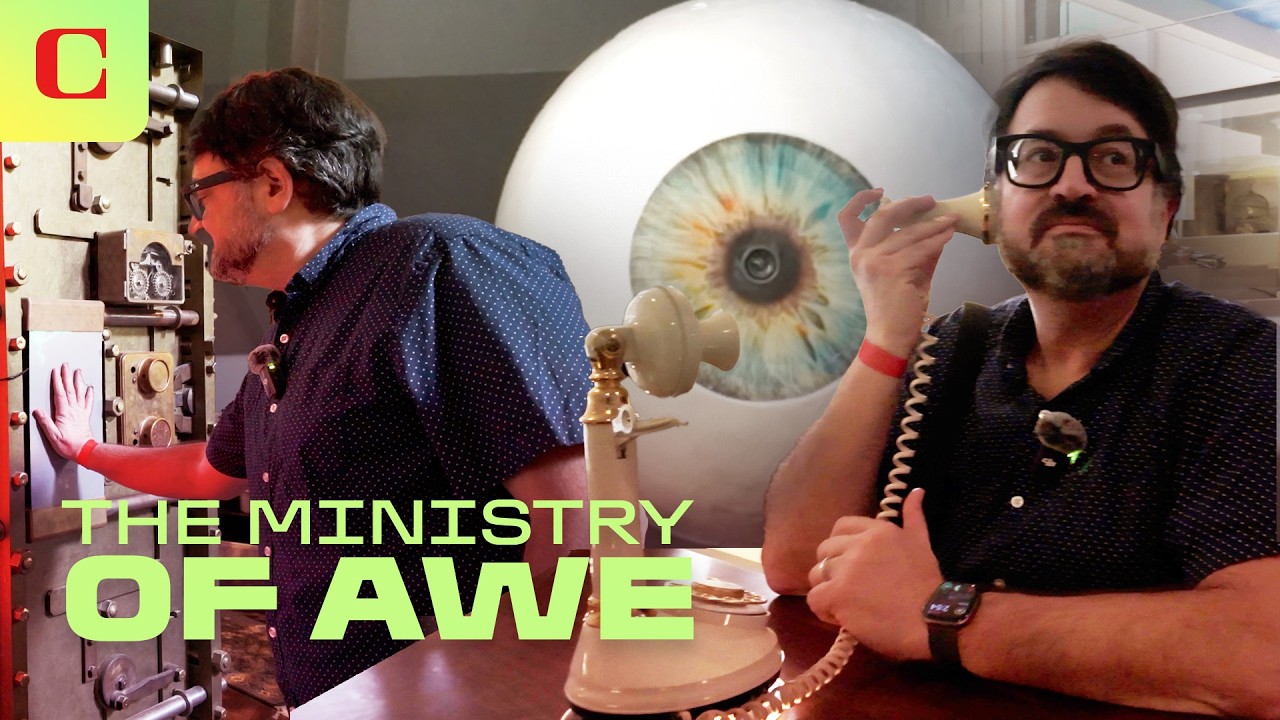
I Was in AWE of This Techie Art Exhibit (Ministry of Awe)
Scott Stein takes you inside the Ministry of Awe, Philadelphia’s immersive six story art experience. Go on a journey with him as he explores how technology and art meet in this space. Hear from the founders of Spatial Pixel, who explain what inspires them to combine AI with this physical art experience. 0:00 Entering the…
Science & Technology
Why Taskrabbit’s Founder Prioritizes Diversity Early │ Build Mode Podcast
As a founder or any team builder, diversity is best built at the start. As Taskrabbit founder Leah Solivan learned, procrastination leads to weaker teams and a harder effort later. We dive into all of her expert tips for builders and founders in the latest episode of our podcast Build Mode right here:



Boys experience more violence when they’re young than you think. Here’s how things change #TEDTalks

The New Science of Eyewitness Memory | John Wixted | TED

Google Speaks on Quantum Hackers and the Threat to Crypto | What the Future
-

 Science & Technology6 years ago
Nitya Subramanian: Products and Protocol
-

 People & Blogs4 years ago
Sleep Expert Answers Questions From Twitter ???? | Tech Support | WIRED
-

 CNET6 years ago
Ways you can help Black Lives Matter movement (links, orgs, and more) ????????
-
 Wired7 years ago
How This Guy Became a World Champion Boomerang Thrower | WIRED
-

 Wired7 years ago
Neuroscientist Explains ASMR’s Effects on the Brain & The Body | WIRED
-

 Wired7 years ago
Why It’s Almost Impossible to Solve a Rubik’s Cube in Under 3 Seconds | WIRED
-

 Wired7 years ago
Former FBI Agent Explains How to Read Body Language | Tradecraft | WIRED
-

 CNET6 years ago
Surface Pro 7 review: Hello, old friend ????
@Sant_ci
March 10, 2025 at 7:02 am
Am I the first person
@happymaker3
March 10, 2025 at 7:08 am
Am I second
@okeogbonna1378
March 10, 2025 at 7:08 am
I’m d 2nd person and 1st.❤
@preethijose1466
March 10, 2025 at 7:11 am
I am whatever comes after you guys !
@sooma-ai
March 10, 2025 at 7:11 am
Plant scientist Giles Oldroyd explores how soybean plants naturally partner with fungi and bacteria to access nutrients, eliminating the need for synthetic fertilizers. He discusses efforts to transfer this ability to cereal crops, potentially revolutionizing sustainable agriculture.
@thilinihewadewage
March 10, 2025 at 7:11 am
2nd 👋
@lelyanra
March 10, 2025 at 7:12 am
For me it is amazing how simple knowledge from one country can become a TED talk in another. Any legume can and IS used for the purpose this dude is talking with the right adjustments, and it has been used extensively in multiple countries of latin america.
@MikeHodge9000
March 11, 2025 at 2:18 am
You didn’t watch the whole video? He’s talking about developing nitrogen fixing cereals, which has never been done.
@JimJonesBeverageCo
March 11, 2025 at 8:15 pm
He’s talking about the coregulation of genes that results in the phenotype that legumes have and how it isn’t actually a novel biological process. That means that through genomic manipulation, we can make cereal crops and other crops be able to have the same association with bacteria that legumes have. It could even mean in some cases that it could be as easy as manipulating the placement of the genes, promoters/manipulating expression levels, or even just epigenetic manipulation.
@SamsonFernendez
March 10, 2025 at 7:29 am
Yes, ALL PROTEINS ORIGINATE FROM PLANTS THOUGH BACTERIA.
@CoRoTEzzz
March 10, 2025 at 7:36 am
if you are intrested in this subject, search for “Embrapa Brasil”…this tecnology is older then you can imagine in Brasil. There are several articles about this, from several institutioons. Congratulations for this video
@Snotkoglen
March 10, 2025 at 9:07 am
Nice research. Will be very useful on the Moon and Mars. Now we need to solve the excessive use of animal based fertilizers. We cant all live on tofu alone, you know.
@Bythirteen
March 10, 2025 at 11:21 pm
ah, but we CAN all live completely without meat consumption…. ::shrug::
@jodi2820
March 10, 2025 at 9:50 am
Thank you,great info😊
@ronkirk5099
March 10, 2025 at 10:41 am
Fun fact: In the industrial agriculture practiced around the world, and particularly in western countries, nearly half of the Nitrogen fertilizer applied to fields is not taken up by plants and ends up polluting surface and ground water. Increasing the number of food/fiber plant species that fix their own Nitrogen and most of the Phosphorus would go a long way toward eliminating the pollution problem.
@Debbie-henri
March 10, 2025 at 12:01 pm
Maybe it’s not do much the grnes that are present/switched on that allow the bacteria to interact with legumes, but those genes that are misding/switched off that ‘allow’ the bacteria to ‘invade’ these nodules.
@paulsoutham2454
March 10, 2025 at 12:03 pm
So he’s advocating GMO of crops to add nitrogen nodules? But with a lot of waffle to hide the GMO aspect. No thanks! Just inter-crop legumes with other plants using regenerative agriculture! No GMO required!
@JimJonesBeverageCo
March 11, 2025 at 8:18 pm
Technically, this would not be GMO. That’s the whole point of the finding.
@LineageCider
March 10, 2025 at 1:37 pm
@kisorganics
@RumanYt-5
March 10, 2025 at 5:37 pm
Which country is this from?
@littleresearch6664
March 10, 2025 at 8:34 pm
Congratulations, Prof.! You are indeed a hope for a sustainable future and a lot of headaches for fertilizer companies!
@Picci25021973
March 11, 2025 at 6:43 am
Ancient cultures did it for centuries. China and India farm this way since 40 centuries ago without exhausting the soil. We, western supertechnological farmers, have thrown away this millenial wisdom to embrace oil based fertilizer and agriculture. In less than 70 yeasr we have devastated our soils, watersheds and atmosphere. Time to go back to school: more biology and less technology!
@varunbaker
March 11, 2025 at 10:37 am
Why not just plant the legumes alongside the grain crops? Why is it necessary to try to replicate this phenomenon in the grain crops if what is important is the soil?
@philiptaylor7902
March 11, 2025 at 11:58 am
Exactly, it’s called crop rotation (alternate three or four crops, including a legume like beans or clover). It’s been common agricultural practice for centuries.
@JimJonesBeverageCo
March 11, 2025 at 8:22 pm
The association is inside the roots, not the soil. To get the levels of fertilizer for all crops at the level we need to reach to stop world hunger once and for all, we need to manipulate the genomes of plants. Lucky for us, this proves that the biological process isn’t novel and we can just easily modify existing genomes of plants, bypassing the need to create GMOs, and can have all crops habs the same root association. The phenotype of root nodules is very important in this case. That is where the association of the mycorrhiza and bacteria actually happen. The bacteria make that gall shape via secretions.
@philiptaylor7902
March 11, 2025 at 11:59 am
Farmers have known this for centuries. It’s called Crop Rotation.
@fritagonia
March 11, 2025 at 1:51 pm
Microbial evolution, wow sounds amazing.