
People & Blogs
Play is what happens when you stop trying to optimize everything #TEDTalks
When was the last time you just … played? Creative health scientist Katina Bajaj thinks adults are in a “play deprivation crisis,” where we’ve replaced our fun-loving human nature with optimization and efficiency. She makes the case that play isn’t a reward for productivity but rather a survival skill — and invites you to rediscover…







People & Blogs
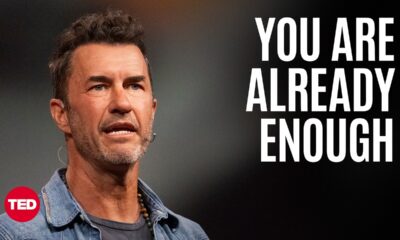
Here’s your reminder that you are enough — and you always will be #WorldMentalHealthDay
On paper, Blake Mycoskie is a glowing success story: he founded TOMS Shoes, building a global brand that has given away more than 100 million pairs of shoes to children in need. Yet despite his success, his struggle with depression nearly cost him his life. In this personal talk, he explores the all-too-common shame that…
People & Blogs
The Three Words That Saved My Life | Blake Mycoskie | TED
On paper, Blake Mycoskie is a glowing success story: he founded TOMS Shoes, building a global brand that has given away more than 100 million pairs of shoes to children in need. Yet despite his success, his struggle with depression nearly cost him his life. In this personal talk, he explores the all-too-common shame that…
People & Blogs
These are the inherent human skills that machines can’t replace #TEDTalks
As AI reshapes work, school and love, what part of being human can’t a machine take over? In a wide-ranging conversation, psychotherapist Esther Perel and TED’s vision steward Sal Khan provide their unique takes on the answer. From personalized learning and AI companions to “emotional capitalism” and the rituals we create to live with uncertainty,…

Here’s your reminder that you are enough — and you always will be #WorldMentalHealthDay

The Three Words That Saved My Life | Blake Mycoskie | TED

Oura CMO Says Wearable Health Tracking Moving Beyond Checkups
-

 Science & Technology6 years ago
Nitya Subramanian: Products and Protocol
-

 People & Blogs5 years ago
Sleep Expert Answers Questions From Twitter ???? | Tech Support | WIRED
-
 CNET6 years ago
Ways you can help Black Lives Matter movement (links, orgs, and more) ????????
-
 Wired7 years ago
How This Guy Became a World Champion Boomerang Thrower | WIRED
-

 Wired7 years ago
Neuroscientist Explains ASMR’s Effects on the Brain & The Body | WIRED
-
 Wired7 years ago
Why It’s Almost Impossible to Solve a Rubik’s Cube in Under 3 Seconds | WIRED
-
 Wired7 years ago
Former FBI Agent Explains How to Read Body Language | Tradecraft | WIRED
-

 CNET7 years ago
Surface Pro 7 review: Hello, old friend ????
@NystulDM
September 20, 2026 at 3:37 pm
many of us know.
it is why my life is devoted to taking people on adventures
@katina bejaj I would love to show you another way. to bring adventure and magic into your life
@chasmenear7130
September 20, 2026 at 4:55 pm
This is the most amazing wisdom – definitely the best TED I’ve seen in quite some time…and that’s saying quite a bit!
@CornCans
September 20, 2026 at 5:06 pm
I expected this to be more playful.
@nokoolaid
September 20, 2026 at 5:41 pm
The American Business Model ruins everything
@riku6146
September 21, 2026 at 6:41 am
It is not even the real capitalism, even though it is a form of capitalism.
Go learn from Prof. Sam Vaknin
@nokoolaid
September 21, 2026 at 9:49 am
@riku6146 I never commented on the type of system it is. It’s crony capitalism/corporatism/consumerism. It’s about profit/productivity/efficiency that benefits the few. The safety valve for the elites is that the hoi polloi get just enough credit so they don’t complain, the debt of which grows every year.
@westrim
September 21, 2026 at 12:20 am
This woman hasn’t a spent a year of life without an income/parental income under 100K, has she?
@begirbigger7843
September 22, 2026 at 3:26 am
@westrim I came to work singing and dancing to my 7 dollars a day job. I ate steamed rice with fried soy bean everyday for months. Now my life is a lot better, but I don’t feel like my life was miserable back then.
@riku6146
September 21, 2026 at 6:40 am
Because capitalism and capitalists wanted bigger numbers with 0 risk taking, not even playful risk taking in most cases
@parthchauhan8721
September 21, 2026 at 2:18 pm
Guest YT Channel FT.@JayShettyPodcast.
FT.@melrobbins
@parthchauhan8721
September 21, 2026 at 2:19 pm
Dr. Ishan Shivanand
Dr. Ishan Shivanand is an academic, philanthropist, founder of Compassion Unites, and one of the leading voices shaping the global response to the mental health crisis.
Peer-reviewed research validates his mental health protocols, now adopted at Google and Fortune 500 companies.
Shivanand advises global governments and CEOs. An award-winning author, his first book, The Practice of Immortality, is a USA Today national bestseller.
@Michael.ZuleykaRivera
September 22, 2026 at 3:46 pm
I have one question… What was the point of this?
Very intelligent individuals talking on TED…. mmmmmhhhhmmmnn
@gulllars4620
September 22, 2026 at 6:50 pm
I disagree. I’m an adult nerd that’s a lifelong gamer and asipring polyglot and polymath working in IT doing creative problem solving. I play leveraging my curiosity. I’m distilling the same into my kids and their kindergarten prioritize gently supervised “free play” with just a bit structured learning, instead guiding with themes and inspiration.
Don’t kill play as a process and intuitive value signal through curiosity. But efficiency and effectiveness are also important things for society and companies, and it can come from directed play and playful exploration (some of your time)
@darinking9479
September 23, 2026 at 5:39 pm
We must because we must is a terrible thesis and closing statement.
@simplyminded3529
September 23, 2026 at 6:29 pm
Very true