
Bloomberg Technology
Intel Needs ‘Customer Wins:’ Creative Strategies’ Bajarin
Creative Strategies CEO Ben Bajarin says it was inevitable that the US government would want to take a stake in Intel to support domestic chip production and national security. Bajarin joins Caroline Hyde and Ed Ludlow on “Bloomberg Tech.” ——– Like this video? Subscribe to Bloomberg Technology on YouTube: Watch the latest full episodes…












Bloomberg Technology
Anthropic Files for IPO in Global Race to Raise Cash for AI
Anthropic filed for its long-awaited IPO, a landmark moment in an industry that is growing ever-hungrier for cash to power ahead. Ed Ludlow reports. ——– Like this video? Subscribe to Bloomberg Tech on YouTube: Watch the latest full episodes of “Bloomberg Tech” with Ed Ludlow here: Get the latest in tech from Silicon…
Bloomberg Technology
Anthropic Drops Its S-1, Giving Market Glimpse Into Finances
Bloomberg’s Ed Ludlow takes a look at Anthropic’s regulatory filing as the company prepares to go public under the ticker ANT. The S-1 revealed Anthropic’s revenue and spending, along with its plan for an unusual corporate structure. Plus, venture investors are in line for a big payday when Anthropic goes public. Matt Murphy from Menlo…

Bloomberg Technology
Anthropic IPO Is the “One We’ve Been Waiting For”: Bessemer’s Deeter
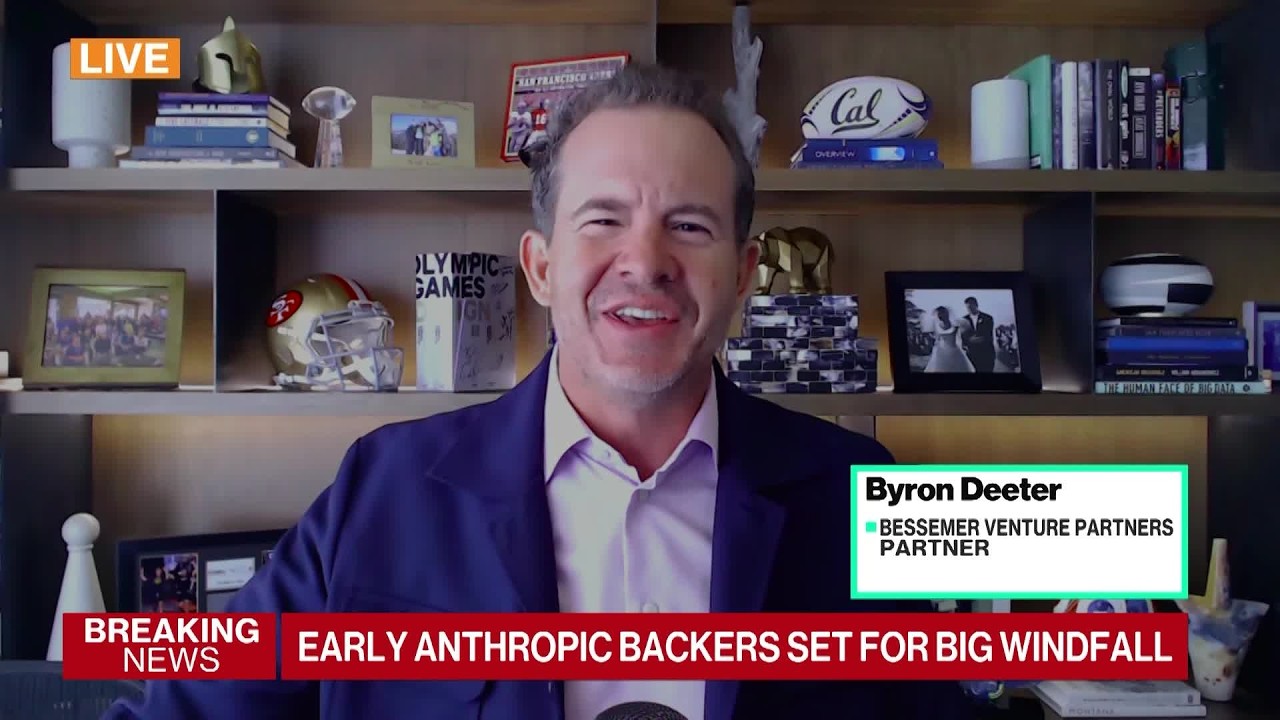
Anthropic’s IPO will finally give public market investors a chance to get into the software side of AI, says Byron Deeter, partner at Bessemer Venture Partners. Bessemer first invested in Anthropic during its Series D, and Deeter explains the impact Anthropic going public will have on limited partners. He joins Ed Ludlow on “Bloomberg Tech”.…

Apple Announces a $699 OLED iPad Mini. What To Know

Does the wire in the Fold-A-Phone keep the iPhone Duo from closing all the way?

iPhone Duo Livestream: How Many Folds Can Apple’s Phone Take? Day 1
-

 Science & Technology6 years ago
Nitya Subramanian: Products and Protocol
-

 People & Blogs5 years ago
Sleep Expert Answers Questions From Twitter ???? | Tech Support | WIRED
-

 CNET6 years ago
Ways you can help Black Lives Matter movement (links, orgs, and more) ????????
-

 Wired7 years ago
How This Guy Became a World Champion Boomerang Thrower | WIRED
-

 Wired7 years ago
Neuroscientist Explains ASMR’s Effects on the Brain & The Body | WIRED
-

 Wired7 years ago
Why It’s Almost Impossible to Solve a Rubik’s Cube in Under 3 Seconds | WIRED
-

 Wired7 years ago
Former FBI Agent Explains How to Read Body Language | Tradecraft | WIRED
-

 Entertainment6 years ago
Former CIA Chief of Disguise Breaks Down Cold War Spy Gadgets | WIRED
@panama-canada
August 15, 2025 at 3:44 pm
I’m surprised Intel still exists
@Diamond_Hanz
August 15, 2025 at 5:28 pm
Buy the dip. If Taiwan’s government and the Chinese government funds their founderies, time to level the playground. Let’s go!
@leonardoruiz5994
August 15, 2025 at 6:03 pm
I dont think the issue with Intel is the technology, they are capable of making leading edge chips, the real issue is the cost and for the investment to be viable they need to secure new costumers in a business that is new for them
@phiayang5952
August 15, 2025 at 8:32 pm
Agreed, Taiwan funded tsmc, US gov will do the same, same as what happen to MP.
@jamesl2590
August 16, 2025 at 1:30 am
Lol. It’s always technology dude. Their production yield is too low. Yield is the % of the chips produced from wafer are fully functional. TSMC is popular because it is able to get a high end chip yield on “Large-scale” production. No customers, in the right mind, will contract Intel to manufacture its chips for their products if its yield is too low. They risk having product quality issues and supply chain problems, such that costs becomes prohibitive. All the chip buyers are dying to diversify their chip sources, instead of being fully reliant on TSMC. If Intel can get its production right, customers will be knocking on its door without Intel asking.
Note that making a few high end chips in the lab environment is very very different from “large-scale” production. Most, even China, can do that in the lab, but none can match TSMC’s large scale production yield.
@z97482
August 16, 2025 at 9:45 am
Their yields are too low to be competitive with current pricing. That doesn’t mean it’s not a viable process but tsmc’s cut-throat pricing makes them not viable. A subsidy or tariff on chip imports would immediately make them viable… I’m not implying this should happen but it’s important to understand
@frank54908
August 15, 2025 at 11:32 pm
Sell intel
@lflyr6287
August 16, 2025 at 3:29 pm
Why not invest in Shintel :
-Shintel 12-th, 13-th and 14-th gen, those are 2 CPU-s under 1 CPU die (e-cores from laptop and p-cores from desktop designs) have a 100 % self-melting mortality rate between 2-8 months from the i5 12400/13400/14400 and up which was proven in 2024 from a 2 year long deep dive research
– Shintel doesn’t know how to design and manufacture a CPU architecture without hardware security holes because they rely on OS Kernel to create a side SW CPU to take certain load of their back so that they can cheat in IPC performance
– Shintel CPU-s use nuclear amounts of PWR
– Shintel CPU-s produce LAVA like temperatures since the coffee lake refresh i7 9700K already
– Shintel CPU-s cannot be cooler by any kind of air coolers since the coffee lake refresh i7 9700K already
– Shintel has been using anti-competitive shady corruptive bribing tactics against AMD for the past 30 years now
– Shintel has been constantly applying anti-consumer tactics since the year 2000
– Shintel has lower single-core performance than AMD
– Shintel has lower multi-core performance than AMD
– Shintel has lower IPC performance than AMD
– Shintel has countless hardware security holes compared to AMD that has none
– Shintel has the highest core count number of 28 on a single CPU package under single CPU die (Xeon W-3275M), while AMD has 192 cores/384 threads on Zen5c Epyc cpu monsters
– Shintel ratio of performance, core count and PWR consumption compared to AMD of literally in the opposite direction of efficiency