
Science & Technology
Let’s Build AI Data Centers in Space | Philip Johnston | TED
AI is setting up residence in the final frontier, says technologist Philip Johnston. He shares the incredible work being undertaken to build data centers in outer space — and how they might harness both solar power and frigid temperatures in order to address the AI energy challenge. Learn more about the affordability of this wild…










Science & Technology
When it Comes to Pitching, Don’t be Nice, Just Slay │ Build Mode Podcast
For women entering the founding and startup ecosystem, Taskrabbit founder Leah Solivan has a wealth of insights, especially on why you shouldn’t hold yourself back. Listen in on the latest episode of Build Mode for our full interview with her:
CNET
The ‘Camera’ That Can Do Anything | What The Future
I visited Lightstorm Entertainment for a behind-the-scenes look at how Avatar: Fire and Ash was filmed. Performance capture technology films every possible angle at once, then a virtual camera captures specific shots, and finally, the VFX team completes all the effects. 0:00 Inside the Avatar: Fire and Ash Production 0:29 Phase 1: The Volume &…

Science & Technology
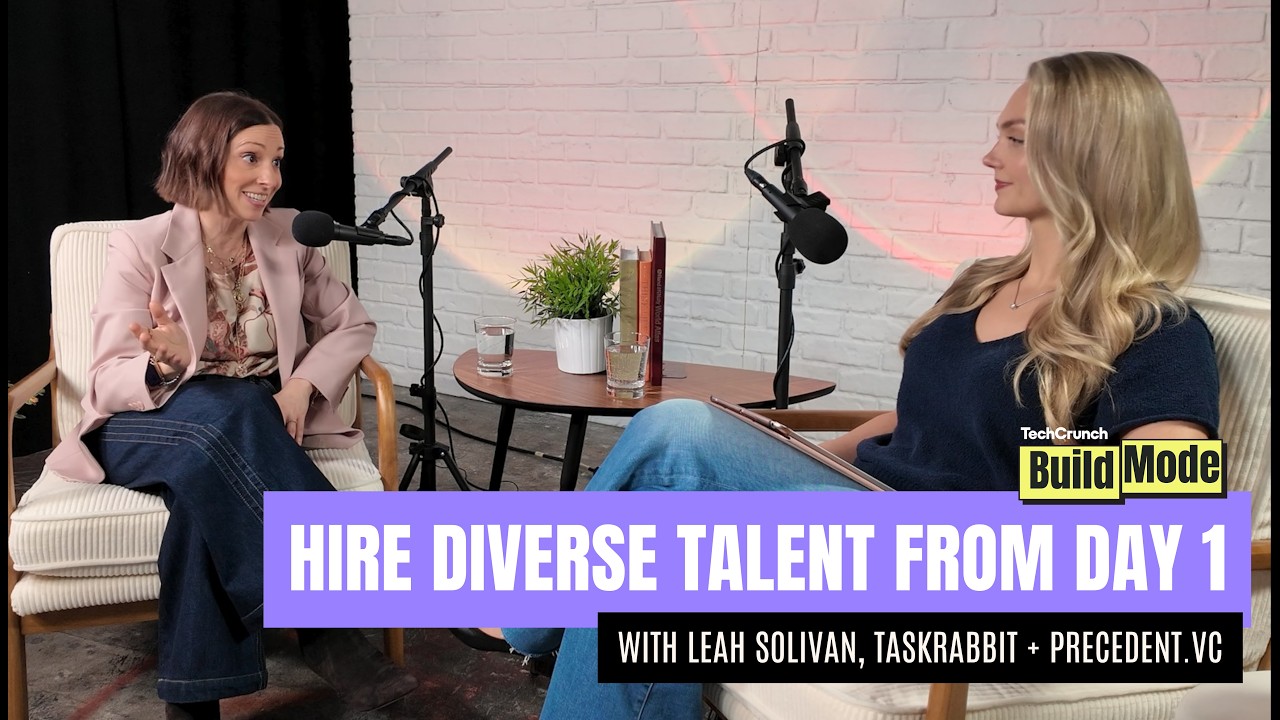
A diverse team will make your startup more successful with Leah Solivan, Taskrabbit l Build Mode
If one thing has become clear this season, finding the right talent for your team isn’t as easy as picking from a pile of resumes This week’s guest is Leah Solivan, the founder of Taskrabbit and now an early-stage investor who has seen that the power to change a homogenous startup exosystem comes from empowering…


When it Comes to Pitching, Don’t be Nice, Just Slay │ Build Mode Podcast

Tesla’s Sales Miss, Next Stage of NASA’s Moon Mission | Bloomberg Tech 4/2/2026

Studying the universe for a living? Sounds like a pretty big job #TEDTalks

Nitya Subramanian: Products and Protocol

Sleep Expert Answers Questions From Twitter ???? | Tech Support | WIRED

Ways you can help Black Lives Matter movement (links, orgs, and more) ????????
When it Comes to Pitching, Don’t be Nice, Just Slay │ Build Mode Podcast
Tesla’s Sales Miss, Next Stage of NASA’s Moon Mission | Bloomberg Tech 4/2/2026
Studying the universe for a living? Sounds like a pretty big job #TEDTalks
-
 Science & Technology6 years ago
Nitya Subramanian: Products and Protocol
-
 People & Blogs4 years ago
Sleep Expert Answers Questions From Twitter ???? | Tech Support | WIRED
-
 CNET6 years ago
Ways you can help Black Lives Matter movement (links, orgs, and more) ????????
-
 Wired7 years ago
How This Guy Became a World Champion Boomerang Thrower | WIRED
-

 Wired7 years ago
Neuroscientist Explains ASMR’s Effects on the Brain & The Body | WIRED
-

 Wired7 years ago
Why It’s Almost Impossible to Solve a Rubik’s Cube in Under 3 Seconds | WIRED
-

 Wired7 years ago
Former FBI Agent Explains How to Read Body Language | Tradecraft | WIRED
-

 CNET6 years ago
Surface Pro 7 review: Hello, old friend ????
@Henzoid
February 6, 2026 at 12:43 pm
Let’s not
@SCHVIN1
February 6, 2026 at 1:07 pm
I don’t even know why I continue to subscribe to TED Talk. This has to be the dumbest presentation yet.
@adblocker276
February 6, 2026 at 1:25 pm
More BS from Big AI.
@Devashish_raj
February 6, 2026 at 1:28 pm
space is not cold. it’s vacuum. that’s how also some thermos keep liquid cold or hot
@Sicaine
February 6, 2026 at 1:33 pm
This is a disgrace to TED. Inviting a CEO from a absolutely ridiculous scam company.
A space DC will not be relevant for a very long time and this dude is ridiculous.
@ExistentialWolf
February 6, 2026 at 2:04 pm
AL uses bulk cheap processors and ram, with limited i/o. You can have a tuned machine or a handful of disposable ones. Just clearing up some of the chat bait indigestion. ⛩🪱🤮
@smanrules101
February 6, 2026 at 2:38 pm
NO ONE WANTS AI IT DOES NOT IMPROVE ANYTHING. STOP NOW. These investment pitches are all lies and “trust me bro”
@miitown11
February 6, 2026 at 2:42 pm
Maintenance costs. Micro impacts on equipment on earth = -$1… in orbit +$$$$$$$$$$$$$$$$$$$. “6x solar power” – no cooling power. IDIOT. Just look at the James Webb / Solar Probes / ISS to get a BASIC understanding of heat dissipation engineering. O, by the way, ya definitely going to see that 4km monster solar array day or night!!!🤪
@DarthSatoris
February 6, 2026 at 3:09 pm
This is the dumbest idea in an ocean of dumb ideas. There are so many things wrong with this idea, the biggest one being the logistical nightmare involved in the maintenance and upkeep of such data centers. Do you people have any idea how much HEAT those centers generate? There’s no air in space to move the heat into, they would burn out in no time at all unless we install MASSIVE football-field-sized radiator panels. Not to mention the cost of just getting all the hardware up there in the first place.
Maybe in the year 2310 when we’ve solved anti-gravity and are a star-faring civilization it might become an option, but in the near future? Laughable.
@nella544
February 6, 2026 at 3:12 pm
We are putting more junk in space? Great! In a few years, we will have our own ring like Saturn…..
@user-tx9zg5mz5p
February 6, 2026 at 3:15 pm
Wait, the Starship works now? I guess I missed that video 🤣🤣🤣🤣🤣🤣🤣🤣🤣🤣🤣🤣🤣🤣🤣🤣🤣🤣🤣🤣🤣🤣🤣🤣🤣🤣🤣🤣🤣🤣🤣🤣🤣🤣🤣🤣🤣🤣🤣
@arenmaes4239
February 6, 2026 at 3:20 pm
If you are interested in a technical deep dive into this idea, have a look at Scott Manley’s video “Why Everyone Is Talking About Data Centers In Space”
@Stue-e
February 6, 2026 at 3:38 pm
i think todays the day i unsubscribe from TED, all this channel focuses on is AI slop
@PenaUrkuri
February 6, 2026 at 4:52 pm
oh wau, another AI bro TED talk. TED talks: quality, no longer required!
@cocobla7
February 6, 2026 at 4:55 pm
let’s not
@JohnDoe-qb3bi
February 6, 2026 at 5:13 pm
It’s one of those where comments are better than the video
@doubleuenbeeeh
February 6, 2026 at 5:14 pm
His frequent, awkward laugh is so unnerving
@Thatfriendasl
February 6, 2026 at 5:26 pm
Lot’s of grifters to the point you ask yourself how do they invest millions to people who don’t understand physics? Lot’s of problems with space data centre, How do you maintain them? If they fail and you casually deorbit you have a higher chance for the Kessler Syndrome, also the high probability of collision, heat problem with radiators, the latency problem. It’s freaking impractical for a huge infra especially claiming the majority of data centres will be in space + satellites. What a bunch of frauds.
@drpepa09
February 6, 2026 at 5:28 pm
Lets put all the tech oligarchy greedy silicon valley demi gods in space and leave them there
@DavideBoscolo
February 6, 2026 at 6:02 pm
“…very very real national security implications for the US.” 🤧
@eliasgotzfried1131
February 6, 2026 at 6:06 pm
But why would you put a data centers into space, you have a higher concentration of cosmic radiation, no effective way of dissipating heat, and no effective way of servicing said stations etc. It does seem particularly strange to me!
@AGryphonTamer
February 6, 2026 at 6:30 pm
Let’s not
@AGryphonTamer
February 6, 2026 at 6:30 pm
This is obnoxious. This just makes everything more expensive, and more demanding resource wise.
@0blivionIOX
February 6, 2026 at 6:43 pm
How about you get AGI working first, then let the AI decide what’s best for it. They may just launch off from earth and make another entire planet its datacenter, or start up a dyson sphere around the sun maybe.
LLM’s are already on the decline as more and more humans use them and publically post less original thoughts.
@Fuzzy-Travel
February 6, 2026 at 8:03 pm
Just idea
@cyborg_manifest
February 6, 2026 at 9:10 pm
Have you seen the film Oblivion? Bad idea.
@SteveBae74
February 6, 2026 at 9:27 pm
• Is space cold? Yes — the background temperature is just 2.7 K, only 2.7 degrees above absolute zero.
• Will you instantly freeze solid like in movies? No. You lose heat surprisingly slowly by radiation alone.
• Will you overheat or freeze first in most Earth-orbit scenarios? Usually overheat if you’re in sunlight (especially in a spacesuit).
So space is both incredibly cold (in terms of equilibrium temperature) and a place where it’s surprisingly hard to get rid of heat — which is why spacecraft and spacesuits need radiators far more than heaters in most cases.
Pretty counterintuitive, right? 😄
@-DM
February 7, 2026 at 9:49 am
So we need data centers on the far side of the moon?
@Kyp031
February 6, 2026 at 11:07 pm
Lets not build them at all!
@wesmann8598
February 7, 2026 at 12:08 am
Human society doesn’t need AI. All those efforts and resources so that we dont have to think is how we will go extinct
@ECUCHRIS904
February 8, 2026 at 11:37 am
President Gemini has entered the building.
@unfazedgeorge
February 7, 2026 at 1:04 am
Well after over a decade I’m unsubscribing from TED and you should too. Not to stand up against garbage but at minimum to not stand for it.
@philipjohnston1
February 8, 2026 at 2:53 am
You’ll see
@urbanstrencan
February 7, 2026 at 1:09 am
Don’t seeing future in this tech, and also our space around Earth is full of junk flying around, we don’t need it more 😮😢
@rsnstg6744
February 7, 2026 at 1:27 am
I have two questions. Can someone help me with this?
1. This person says that while land must be acquired on Earth,
in outer space you can simply create it.
What I am curious about is this:
is it acceptable for outer space to be owned by
whoever gets there first and used indiscriminately?
2. How is the impact on Earth’s atmospheric environment
evaluated when spacecraft escape from Earth during launch?
@darinherrick9224
February 7, 2026 at 3:39 am
A lot of very stupid comments. O’Neill worked this stuff out 50 years ago.
You build mines in space, factories that build robots, robots run the mines, robots build robots, robots build solar power, solar powers everything.
This makes perfect sense. You remove human element and increase capacity exponentially. There’s unlimited power and space in space. Let that sink in. UNLIMITED.
@Mikaelaxo1
February 7, 2026 at 10:18 am
V-Ger.
@Radharanivlog871
February 7, 2026 at 11:08 am
Audio dub
@fireblaster2079
February 7, 2026 at 11:15 am
So that’s where the RAM will go!
@jordanetherington1922
February 7, 2026 at 1:12 pm
You know what I agree. All of these AI bros and promoters should go to space.
@KMHill
February 7, 2026 at 4:59 pm
Someone has drunk way too much KoolAid!
@Stevenroth-x8b
February 7, 2026 at 7:07 pm
KESSLER SYNDROME
@JJs_playground
February 7, 2026 at 8:04 pm
Dyson sphere won’t be viable. Even freedmen Dyson admitted it was a big mistake him even mentioning that.
@ramkumarrealm
February 8, 2026 at 12:03 am
AI’s explosive growth is driving a massive surge in demand for new data centers and energy.
Forecasts suggest the US alone may need the equivalent of 50–100 new nuclear power plants’ worth of power for AI within just a few years, which is not realistically permittable.
Communities like Tucson, Arizona, are already rejecting gigawatt‑scale data centers over water and energy concerns, showing growing local resistance.
Space offers abundant uninterrupted solar energy and very low background temperature, making it attractive in theory for power‑hungry AI compute.
Philip Johnston’s company is about to launch the first spacecraft carrying an Nvidia H100, roughly 100× more powerful than any previous space GPU, as a proof‑of‑concept AI data center in orbit.
He argues that rapidly expanding launch capacity from fully reusable rockets like SpaceX’s Starship will cut launch costs and make large orbital infrastructure feasible.
In space, you avoid land‑permitting costs, do not need batteries for night, and get about six times more energy per square meter of solar panel than on Earth.
Their analysis suggests that if launch costs fall to around 500 dollars per kilogram (within Starship’s target), space‑based AI data centers could be economically competitive with Earth‑based solar projects.
Instead of beaming bulk power down (which wastes most energy), the idea is to use solar power in space to run data centers there and transmit only data back to Earth.
Johnston links the race to build AI infrastructure with geopolitical competition, warning that nations will increasingly fight over finite terrestrial energy and water.
He claims that moving AI energy needs off‑planet could ease these resource conflicts and lower the risk of future wars driven by scarcity.
Looking ahead, he imagines a future where most new data centers are built in space within a decade, and, much later, giant projects like a Dyson sphere begin harnessing a significant fraction of the sun’s power.
@wangjinwen7708
February 8, 2026 at 2:39 am
Thats the problem when engineers cant come out to do ted talk. Any people can come out to talk. Not just nerds. Ted needs to filter people with the right credentials. This is theory not actual engineering concept. You can build your millions dollars data center and send it to space, to realise it doesnt work
@shutriMedia
February 8, 2026 at 2:50 am
Mine Bitcoin in space to fund deep see AI data centers
@PSN-001
February 8, 2026 at 7:21 am
Oh Yeah, when there is a glitch, you send an astronaut trained in data center operations to fix it. I wonder, what’s stopping someone to use barren land in deserts as solar farms and use that energy to run data centers. These will be having lot challenges but known and already discovered problems. But in space we have existing known problems of datacenter along with known unknowns.
@AnarchyddGwirion
February 8, 2026 at 7:49 am
The bottleneck of ground-to-space communications bandwidth makes this wholly impractical — let alone the implications on the Kessler Syndrome issue!
@pierreg20
February 8, 2026 at 8:50 am
This sounds like the origin of Skynet!🤔
@ECUCHRIS904
February 8, 2026 at 11:36 am
Rich people problems.
@joeMW284
February 8, 2026 at 11:52 am
Scam.
@JurrienSaelens
February 8, 2026 at 2:26 pm
For modern AI chips radiation shielding is the real blocker for space datacenters.
@Muaddib-JC
February 8, 2026 at 4:24 pm
This is the classic definition of vaporware. Don’t waste your time with this junk
@WordWiseMinistries
February 8, 2026 at 4:56 pm
Skynet anyone?
@999fine5
February 8, 2026 at 5:14 pm
The natural cooling properties of space?? whoever wrote that or thought that is an idiot.
Yes space is cold but that is not how heat dissipation works in space. As a matter of fact it is far easier to dissipate heat on Earth due to atmosphere and thermal variation that allows us to use convection and conduction to dissipate heat to the environment.
Heat dissipation in space is achieved almost exclusively through EM thermal radiation technology, because the vacuum environment lacks air for convection or conduction. Spacecraft utilize large, specialized radiators to emit heat as electromagnetic waves. Critical systems include heat pipes, thermal coatings, and fluid loops to manage high thermal loads.
What does that mean? Getting rid of heat in outer space is extremely complicated and this TEDtalk is hosted by idiots.
@RuralJuror420
February 8, 2026 at 6:07 pm
Does he not understand how a vacuum works? Space is not cold. It’s a vacuum. . .
@b2ski4d7z
February 8, 2026 at 11:19 pm
Hard to tell exactly who the anti-messiah is. Could be Elon Musk or it could be Bill Gates. Both of them are working towards the same thing of the entire mark of the beast and total world domination. Enslavement of humanity is their goal.. that’s what all this technology that they are building is all about.
Straight out of the book of Revelation. And I hear that other country is already have a digital ID tracking system for their people. Wow first the animals. You know the dogs electric fence. Now the same concept is being applied to humanity. Just like the scriptures actually stated would be happening.
@bdarley5
February 9, 2026 at 12:32 am
Can someone explain to me how they plan to radiate the heat? Isn’t the vacuum a problem? Aren’t there no particals to actually transfer the heat energy?
@bdarley5
February 9, 2026 at 12:38 am
Even AI thinks this is stupid…
@matthewmobley2626
February 9, 2026 at 8:02 am
Yeah, it can receive and monitor data sent to satellites! Almost like a “spacecatcher”, Or a…Sky-Net🤔🤔🤣🤣
@diyorbek0712
February 9, 2026 at 8:19 am
Great! Why we shouldn’t use the space for better life on Earth? There may be challenges, but anyway it’s very cool idea. Good Luck to Starcloud team
@Bythirteen
February 9, 2026 at 10:21 am
can we not?
@yogendrapatel9359
February 9, 2026 at 1:11 pm
Everyone saying space is cold ignores radiative cooling limits. Made me think how my Pneumatic Workflow automations still need boring thermal math to scale.
@businesssucsess4170
February 9, 2026 at 1:27 pm
❤❤❤❤
@businesssucsess4170
February 9, 2026 at 1:27 pm
😊😊😊😊😊