
Science & Technology
Most Countries Fail at Clean Energy. Here’s How Mine Succeeded | Sebastián Kind | TED
Energy expert Sebastián Kind helped Argentina go from virtually no renewable energy to generating nearly 40 percent of its electricity from wind and solar in just six years, despite economic crises and skepticism. How did the country’s transition off fossil fuels happen so quickly? He shows why the key breakthrough didn’t hinge on technology or…












Science & Technology
Don’t Give VCs More Leverage Than You Have To
Investors know when a founder is desperate. Sasha Orloff has raised a collective $1 billion in his career and he shares his advice for staying on top of your financial situation. Listen to the full episode of Build Mode with Puzzle’s founder and CEO:
Science & Technology
The Singularity Isn’t the Real Reason Stripe Paid $7.5B for OpenRouter
Stripe claims “the singularity” is here, and justifies its $7.5B acquisition of OpenRouter. The truth, as the Equity podcast crew highlights, is much more practical, as unglamorous as token expense management may seem:

Science & Technology
Why is the DOJ investigating Andreessen Horowitz over board seats? | Equity Podcast
Andreessen Horowitz has two partners sitting on the boards of companies that now compete with each other: Ben Horowitz at Databricks and Martin Casado at Fivetran. Nothing too scandalous on the surface, except the Department of Justice has reportedly been investigating the arrangement for almost a year, dusting off a 112-year-old antitrust law that’s rarely…


Don’t Give VCs More Leverage Than You Have To

Khosla Ventures Bets on AI’s Next Frontier: Science

Meta Safety Trial Could Reveal What Zuckerberg, Others Knew
-
 Science & Technology6 years ago
Nitya Subramanian: Products and Protocol
-

 People & Blogs4 years ago
Sleep Expert Answers Questions From Twitter ???? | Tech Support | WIRED
-

 CNET6 years ago
Ways you can help Black Lives Matter movement (links, orgs, and more) ????????
-
 Wired7 years ago
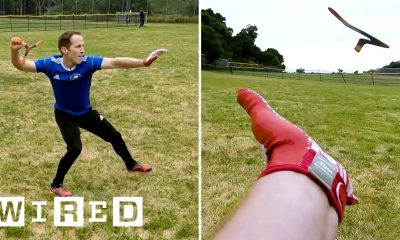
How This Guy Became a World Champion Boomerang Thrower | WIRED
-

 Wired7 years ago
Neuroscientist Explains ASMR’s Effects on the Brain & The Body | WIRED
-

 Wired7 years ago
Why It’s Almost Impossible to Solve a Rubik’s Cube in Under 3 Seconds | WIRED
-

 Wired7 years ago
Former FBI Agent Explains How to Read Body Language | Tradecraft | WIRED
-

 CNET7 years ago
Surface Pro 7 review: Hello, old friend ????
@vkook40825
October 6, 2025 at 11:04 am
Hiiiiiiiiiiiiiiiiiiiiiiiiiiiiiiiiiiiiiiiiiiiiii
@AdvantestInc
October 6, 2025 at 11:23 am
Turning instability into opportunity, this talk is a reminder that innovation thrives where the right frameworks meet bold vision
@zepenance9571
October 6, 2025 at 11:37 am
Greed. Its profitable.
There you go. Didnt even watch the video and i told you.
@mindful-789
October 6, 2025 at 11:49 am
Amazing!
@Sir_Davidius
October 6, 2025 at 6:52 pm
This is a much better approach to the climate crisis than throwing paint at things
@ReggieDyson
October 6, 2025 at 8:24 pm
Low cap now, but the potential upside is massive. Keep an eye on Belvarium Network
@FelipeWren
October 6, 2025 at 8:24 pm
Don’t fade Belvarium presale just because it’s early — that’s where the real gains come from.
@KarolynOsman
October 6, 2025 at 8:24 pm
Belvarium Network doesn’t rely on hype — they’re building real infrastructure.
@JesusGriffith
October 6, 2025 at 8:24 pm
It’s early, but the Belvarium network community is growing FAST.
@SatyaConrad
October 6, 2025 at 8:25 pm
There’s not a lot of noise around Belvarium BLV yet. That’s exactly what I love.
@SalvatoreWare-b5m
October 6, 2025 at 8:26 pm
Remember when AVAX and SOL were under $1? Belvarium Network is at that stage.
@robwyyi
October 7, 2025 at 11:17 am
This talk is pointless in light of who will be demanding most of the energy. I believe in renewable but I see the reality. The reality is the need of electricity by data farms is driving electricity cost. Future planned generation plants will fall short of AI needs. Fossil fuel plants won’t be shutting down anytime soon because of this. Any talk about renewable or in general electricity is pointless without including AI & data farms power needs. The need is such that nuclear energy has to be included to cover our electricity needs. A thorough discussion of power generation will be forced on us once power cost becomes 2nd highest cost to consumers after their mortgage bill. If it hasn’t already for some.
@joem0088
October 7, 2025 at 12:27 pm
what ? Replicate Argentina every where else ? You must be joking 😂
@alistairbascom6933
October 7, 2025 at 6:09 pm
40% from Wind and Solar is good.